Recently, the team led by Qin Gaowu from NEU has made an important progress in the field of magnesium alloy. Through a very low alloying process, the Mg-Ce-Al alloy in the state of extrusion has acquired a high yield strength (~ 365 MPa). By adding a trace amount of Al (0.05 wt.%) into the Mg-0.2 wt.% Ce alloy, it can facilitate the formation of rich Ce-Al segregation along dislocation and crystal boundary, thereby effectively balancing the restoration of thermally activated dislocation and guaranteeing the grain refinement (
Seen from the perspective of resource-saving and sustainable material, the concept of high strength and low alloy content is of great significance to the design and development of magnesium alloy.
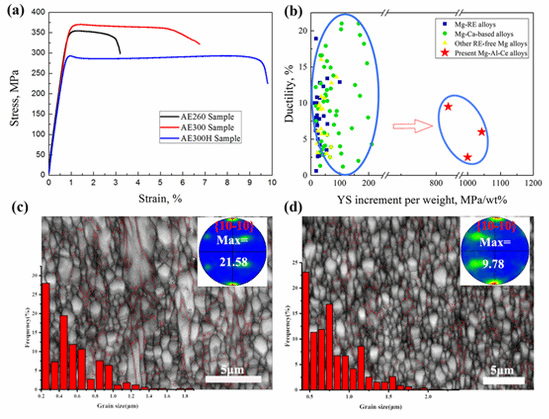
Fig. 1 (a) The nominal stress-strain curve of test samples AE260, AE300 and AE300H; (b) “YS increment per weight” and ductility distribution map of existing Mg-Ce-Al alloy and earlier reported Mg deforming alloy. (c) and (d) are the EBSD images of extruded Mg samples AE260 and AE300 respectively. The attached pictures are the {10-10} pole figures.
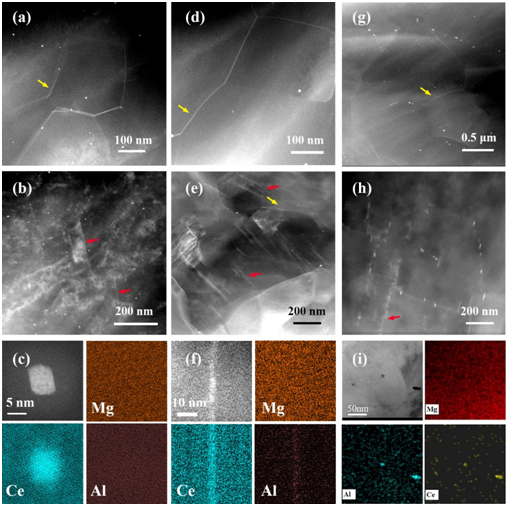
Fig. 2 (a-f) and (g-i) are the HAADF-STEM images of the test samples AE300 and AE300H respectively, which prove the existence of nanometer Mg12Ce phase and Al-Ce phase and GB segregation.
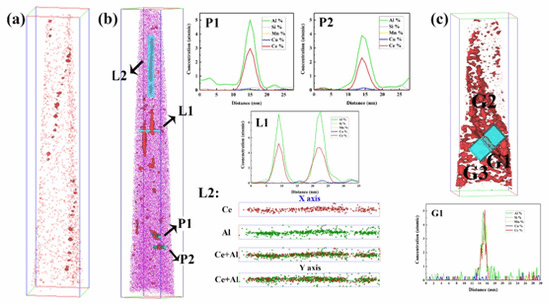
Fig. 3 The APT analysis results of the sample AE300




 NEU
 Login
 中文
